The challenge.
Our client supplies products to Volvo in Sweden. The products are inspected in a laboratory. If the result of the first inspection is not to specification, a 2nd inspection can be carried out. This requires the product to go back into the process to take a sample that goes back to the laboratory for inspection. The lead time of this 2nd inspection process was felt to be "very long" (4 weeks was said). Flowant was asked to actually find out what the lead time of the process is and what causes (too) long lead times.
Our approach.
In 8 weeks, we actually, based on data analysis, determined what the lead time is and where the long lead times are in the process. At the same time, we used interviews to elicit emotion and opinions about the process (and each other...) in order to check perceptions against facts.
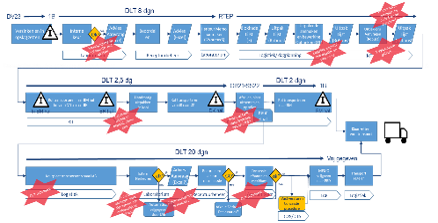
- Based on interviews, the current process was identified and the perceived bottlenecks (see figure above)
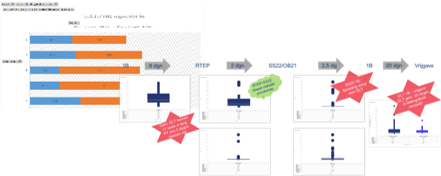
- Based on a large data set, the actual lead time of the various process steps was mapped using Excel and Spotfire (data analytics program) (figure below)
- All stakeholders in the chain were included in the interviews and analysis, together the solutions were determined and implemented